Written by Dr. Helen De Cruz primarily for professional philosophers, but I think it's relevant for proposals in other fields as well: here
Saturday, September 28, 2013

Friday, September 27, 2013
Neil DeGrasse Tyson at 'Beyond Belief' Conference
On the parallel exuberance of science and religion
*Dove: substituting one farce for another
I've been meaning to comment on this for a while but stepped back to think about it some more. And now, quite a bit of time has passed but I think it still warrants some commentary. My thoughts are still incomplete on the matter, and I may be wrong in certain points of the campaign timeline, but I figured I'd try and write some of it out anyway.
(*I know this is a touchy topic, and bold still for a male to be writing on but...)
So Dove has, for some time now, made an active effort to create positive body images for women who don't fit the skinny model mold that is so often glamourized in magazines, tv, movies, and so on.

They've taken the initiative to focus and campaign on "real beauty" with an attempt to invigorate the discussion on what media does to the self-esteem and pressures placed on physical features of women that motivate the vanity fair we run in many societies today. As the ad the left states"the company made the decision to use real women" in hopes that this will boost their product and be more "real" with the people. The ad below considers the issue of self-perception and attempts to shed some light:
In this way, Dove has taken an active or rather open stance about their approach and the photoshopping techniques used to construct a fake image that the models themselves do not live up to:
There have been several documentaries that have attempted to shed further light on the detrimental effect media (television, movies, magazines, billboards, etc.) have had on the body image of women of all ages.A few examples are 'America the Beautiful', 'Killing us softly', 'Miss Representation', and many more. There is a blog (highly recommended) that also focuses on this issue, among other things, at sociological images.
Relatively recently, Dove Canada posted an ad about a trojan horse that targets photoshoppers and what they do to get pictures into a form that is advertisement-ready:
In this particular ad, the target audience are the photoshoppers who get paid to do what they do for advertising agencies and other companies. It's in fact, a very unrealistic attempt to "open the eyes" or "wake up" photoshoppers to a revolution and stand for the principle that what they are doing is "wrong"; as if the photoshoppers are going to stop what they do and leave their job on moral grounds. This, unless you work with a premise that photoshoppers do not have financial concerns, is blatantly absurd. Money as a method of sustaining a lifestyle is also one of the many primary reasons revolutions cannot be maintained. At one point or another, people need to return to the system and make money - pay bills, buy food, feed their children, etc. etc. Escaping the capitalistic cycle is tremendously difficult.
A friend of mine pointed out that Dove, unbeknownst to a male like myself with no particular interest in women's beauty products (whatever commentary that may warrant), is under the auspice of 'Unilever' that also carries brands such as 'Fair & Lovely' "that blatantly promote racism and skewed beauty ideals in India and other countries." The operations of such a company undermines the work that Dove does. However, as any major corporation with multiple brands, it doesn't strike me that the Unilever corporation itself is concerned with women's issues or contradicting campaigns by their brands. The liberal market is about one thing: profit. Much like the satirical comment written by Oliver Stone for Gordon Gecko in the movie 'Wall Street': "Greed is good". This insulates the market, the U.S. market and those that take it as their model, from any moral accountability as long as it makes money. This is a systemic concern about the economy, the market, and how it operates, which warrants another critique that many with much bigger status and intelligence capital than I, have concerned themselves with - Zizek, Badiou, Sandel, etc.
What I would like to bring out is some of the absurdity with Dove's campaign on "real beauty", which they justify with using "real women" in their advertisements.
 (this ad is particularly weird, as if 'real women' are only 'white women' but anyway...)
This campaign of 'real women', 'love your body', 'inner beauty' (all very nice mantras) seems to cross with another campaign that has in a way glorified bigger women, the plus-size, whatever euphemism you want to use. There is a danger with this: it excuses obesity, neglects health, creates a false notion of solution. Take for example, this sly subliminal jab that perpetuates what Dove seems to be fighting against:

This advert still enforces the statement, bigger women are much more challenging than 'size 8 supermodels' in "firming the thighs" and etc. That is, bigger women are much more difficult to fit into the mold of "beauty" that standardizes the market and the human psyche today. Now I really don't know if it is more difficult to "firm the thighs" of one type of model over a bigger model and if "skin" products are really the solution to "firming thighs". I guess I always presumed exercise and healthy eating was the way. But this ad in itself, creates the impression that skin products are, the one and only, solution to tightening skin and creating the effect that women want. This, granting my assumption just mentioned, is a gross mischaracterization.
The problem with this kind of ad campaign and its moral message is that it is limited in what it promotes. Your body is not a product of skin products but a whole myriad of things. More specifically, what you eat and how active you are - it would seem safe to say - are direct factors that influence your body. Yes, there are genetic dispositions that can't be helped. But being active and healthy is fundamentally a choice. Some people just don't have the "time" and body image may not be a concern, which is fine - live your life how ever way you deem fit to live it. Some of the greatest pleasures are palatable aesthetic experiences. If 'time' and managing 'health' are concerns on your list, there are little things in terms of food and other things - walking, biking, taking the stairs, drinking water or tea instead of 'diet' soft drinks, etc. etc.. I'm not trying to say what you should or ought to do; do what you do and love life, I'm just saying - excuses are easy and this is what Dove is doing (intentionally or unintentionally).
The moral message of "real women" and "real beauty", at the end of the day, is still selling a Dove product. Substituting one farce for another and impressing a dependency on skin products. The problem and solution to all your beauty concerns: Be "real", use Dove.
*Note: the same about body image goes for men and muscle products or whatever supplements. I only focused on Dove and its approach to women.
(*I know this is a touchy topic, and bold still for a male to be writing on but...)
So Dove has, for some time now, made an active effort to create positive body images for women who don't fit the skinny model mold that is so often glamourized in magazines, tv, movies, and so on.
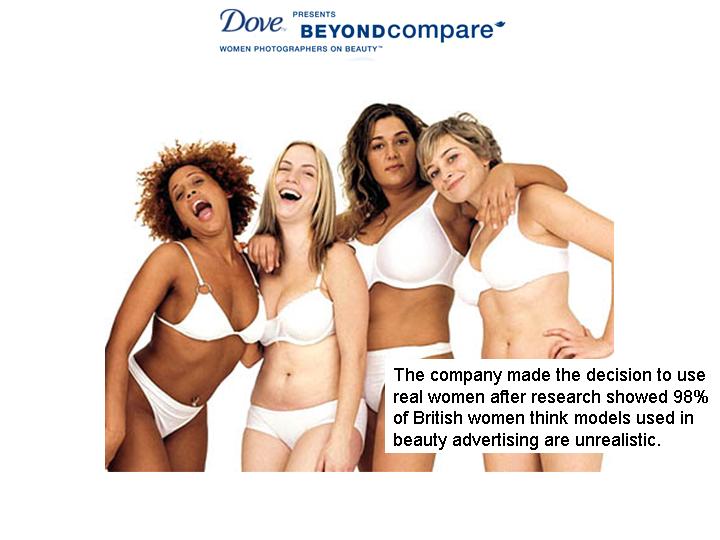
They've taken the initiative to focus and campaign on "real beauty" with an attempt to invigorate the discussion on what media does to the self-esteem and pressures placed on physical features of women that motivate the vanity fair we run in many societies today. As the ad the left states"the company made the decision to use real women" in hopes that this will boost their product and be more "real" with the people. The ad below considers the issue of self-perception and attempts to shed some light:
In this way, Dove has taken an active or rather open stance about their approach and the photoshopping techniques used to construct a fake image that the models themselves do not live up to:
There have been several documentaries that have attempted to shed further light on the detrimental effect media (television, movies, magazines, billboards, etc.) have had on the body image of women of all ages.A few examples are 'America the Beautiful', 'Killing us softly', 'Miss Representation', and many more. There is a blog (highly recommended) that also focuses on this issue, among other things, at sociological images.
Relatively recently, Dove Canada posted an ad about a trojan horse that targets photoshoppers and what they do to get pictures into a form that is advertisement-ready:
In this particular ad, the target audience are the photoshoppers who get paid to do what they do for advertising agencies and other companies. It's in fact, a very unrealistic attempt to "open the eyes" or "wake up" photoshoppers to a revolution and stand for the principle that what they are doing is "wrong"; as if the photoshoppers are going to stop what they do and leave their job on moral grounds. This, unless you work with a premise that photoshoppers do not have financial concerns, is blatantly absurd. Money as a method of sustaining a lifestyle is also one of the many primary reasons revolutions cannot be maintained. At one point or another, people need to return to the system and make money - pay bills, buy food, feed their children, etc. etc. Escaping the capitalistic cycle is tremendously difficult.
A friend of mine pointed out that Dove, unbeknownst to a male like myself with no particular interest in women's beauty products (whatever commentary that may warrant), is under the auspice of 'Unilever' that also carries brands such as 'Fair & Lovely' "that blatantly promote racism and skewed beauty ideals in India and other countries." The operations of such a company undermines the work that Dove does. However, as any major corporation with multiple brands, it doesn't strike me that the Unilever corporation itself is concerned with women's issues or contradicting campaigns by their brands. The liberal market is about one thing: profit. Much like the satirical comment written by Oliver Stone for Gordon Gecko in the movie 'Wall Street': "Greed is good". This insulates the market, the U.S. market and those that take it as their model, from any moral accountability as long as it makes money. This is a systemic concern about the economy, the market, and how it operates, which warrants another critique that many with much bigger status and intelligence capital than I, have concerned themselves with - Zizek, Badiou, Sandel, etc.
What I would like to bring out is some of the absurdity with Dove's campaign on "real beauty", which they justify with using "real women" in their advertisements.

This campaign of 'real women', 'love your body', 'inner beauty' (all very nice mantras) seems to cross with another campaign that has in a way glorified bigger women, the plus-size, whatever euphemism you want to use. There is a danger with this: it excuses obesity, neglects health, creates a false notion of solution. Take for example, this sly subliminal jab that perpetuates what Dove seems to be fighting against:

This advert still enforces the statement, bigger women are much more challenging than 'size 8 supermodels' in "firming the thighs" and etc. That is, bigger women are much more difficult to fit into the mold of "beauty" that standardizes the market and the human psyche today. Now I really don't know if it is more difficult to "firm the thighs" of one type of model over a bigger model and if "skin" products are really the solution to "firming thighs". I guess I always presumed exercise and healthy eating was the way. But this ad in itself, creates the impression that skin products are, the one and only, solution to tightening skin and creating the effect that women want. This, granting my assumption just mentioned, is a gross mischaracterization.
The problem with this kind of ad campaign and its moral message is that it is limited in what it promotes. Your body is not a product of skin products but a whole myriad of things. More specifically, what you eat and how active you are - it would seem safe to say - are direct factors that influence your body. Yes, there are genetic dispositions that can't be helped. But being active and healthy is fundamentally a choice. Some people just don't have the "time" and body image may not be a concern, which is fine - live your life how ever way you deem fit to live it. Some of the greatest pleasures are palatable aesthetic experiences. If 'time' and managing 'health' are concerns on your list, there are little things in terms of food and other things - walking, biking, taking the stairs, drinking water or tea instead of 'diet' soft drinks, etc. etc.. I'm not trying to say what you should or ought to do; do what you do and love life, I'm just saying - excuses are easy and this is what Dove is doing (intentionally or unintentionally).
The moral message of "real women" and "real beauty", at the end of the day, is still selling a Dove product. Substituting one farce for another and impressing a dependency on skin products. The problem and solution to all your beauty concerns: Be "real", use Dove.
*Note: the same about body image goes for men and muscle products or whatever supplements. I only focused on Dove and its approach to women.

*On Generation Y Protagonists & Special Yuppies (GYPSYs)
There's been an article roaming around about Generation Y and "happiness" or rather "un-happiness".
The article's title is provoking by calling a whole generation: "Yuppies", so it's calling people out and basically trying to argue that this generation is "unhappy" because of this given stance of "expectation".
So who is this Generation Y or what the author calls "GYPSYs" ('Gen Y Protagonists & Special Yuppies' lol)? I've never found these generation titles very convincing or ever figured out what they actually mean and why they're given a particular letter to denote a generation. I mean, what about the generations in between? Why don't they have a letter and a personality type? Anyway... the author is quite specific and says that Generation Y is the group of people born between the late 70s and the mid 90s.
First off, this is a huge number of people. Born between the late 70s and the mid 90s is a span of 15-20 years, and this group of people are GYPSYs - Yuppies who are protagonists to their lives and consider themselves "special" - which is a tacit attack on the neo-liberal psychology. By which I mean the attitude of "I can change the world if I work hard enough" type romanticism that tends to bleed into politics and foreign policy. I'll come back to this later on.
So it seems the GYPSY generation is somewhat of an arbitrary category of people born between a certain time period. Given that this is the Huffington Post, I am going to assume that this is really demarcating either the West or just simply the United States. Talking about the G.I. Generation, the Baby Boomers, and the economic prosperity launched by a slew of de-regulation policies implies as much. If my assumption is correct, there is already a red herring building here. The cultures and subcultures within the West and the United States is extremely diverse. People born from all parts of the world and with a great variety of various upbringing and socio-economic class and so on.
The claim is that this GYPSY generation is "unhappy". Continuing with the demographic critique, does this mean that all GYPSYs regardless of background and socio-economic status "unhappy"? Can we really lump white, black, brown, yellow, pink, purple, and blue all into a single category? Outside of being born in a certain time frame, I find it highly problematic to generalize in this way. But maybe the author is generalizing with a particular ethnocentric view: white, american, middle-upper class labeled 'GYPSY,' because it's just easier and safer to do it that way. And even still there are some issues by calling this generation, in a sense, delusional and unhappy.
So my first question to the author, and this GYPSY category, is who are we really talking about here? Are we really going out on a limb and claiming that all people born between the late 70s and the mid 90s are "unhappy" because of a generational psychology that landed them in a privelaged platform to begin life? I just don't find it plausible - platforms of all types vary. The author needs to be a bit more specific when talking about something like this. But hey, it's an article meant to provoke, bring facebook "likes" or dislikes, stir conversation and bring viewers to the Huffington Post. Not that I have anything particularly against the Huffington Post, just pointing out that it is one of many online news agencies that want to attract people.
The second thing is this definition of "happiness" and it's boiled down to a simple formula. Happiness is Reality - Expectations. Author states: "when the reality of someone's life is better than they had expected, they're happy. When reality turns out to be worse than the expectations, they're unhappy."
While there is something to be said about the contrast between experience and expectation, the illusion is that this contrast is the basic perspective for why persons are "happy" or "unhappy". I find this way too static. Expectations and experiences are always changing and we are continuous in a diachronic fashion. Any kind of happiness or unhappiness is always temporary - if we stick to this reality and life and expectations dialectic. One's perspective on life is always, in a sense, evolving and changing - life and reality is dynamic. The author would have had a better argument if the generalization was about an 'attitude to life' and a persistent demand of entitlement and self-centredness, or egocentrism, as opposed to a singular stance of expectation and experience. But let's give this the benefit of the doubt and grant that this formula is meant to be dynamic and continuous. So...does this mean that when reality is better than expectation one is "happy". 'Happiness' is such a weird concept, I don't know if any one person can generalize their life as just "happy" because things are better than expected. Any dynamic consideration between expectation and experience is bound to have spurts of "unhappiness" in between. I mean, what person doesn't see oscillations of good and bad things happening in life? So what does it mean when somebody says that they are "happy" in life? It's an elusive concept and can lead into a whole different direction about existential angst, crises of meaning, and the role of emotions into a formulaic perspective of happiness in terms of expectation and reality. And I have no intention of delving into that here.
So the author goes on to attack a strawman family with a character named "Lucy" and argues why Lucy is unhappy. The basic argument is that Lucy's parents and grandparents never had it as good as Lucy. So they have a different outlook on expectation and reality, where they can draw on past experiences and say 'oh we had it really rough back then' and now things are "AMAZING" - to quote Louis CK, which is true - technology is pretty amazing. And Lucy, because her life has been sheltered, given great things from the beginning, with the nice house on the hill and the white picket fence, with a lawn, and a dog, and a cat, and a goldfish, that her expectations of what should be granted are so grandiose that they are unrealistic and delusional. So when reality comes along and GYPSYs can't get what they want and expect, they are unhappy.
Furthermore, Lucy has been raised to think that she's special and that she can "be whatever you want to be" and grows up thinking that she can be this great protagonist, "wildly ambitious" , who is going to make the world all rainbows and unicorns because Jesus loves you. (*Just by looking at the generational picture the author is painting it seems that my assumption about this GYPSY category is white, american, middle-upper class, and Christian - this is an assumption as well, but let's face it most white people of this category are nominally "Christian"). The author is basically saying that this generation of people are delusional and spoiled. Yuppies. And there is, I think truth to this, there is a neo-liberal psychology that pervades a demographic of America, which is coupled with a ridiculous sense of entitlement. Louis CK picks up on this kind of spoiled attitude that, I'm sure many of us can attest to, a lot of Americans have. For example (up to the 7:30 mark):
It certainly has not helped the image of Americans in the rest of the world. So if we take the attitude Louis is describing with Prof. Handler, an anthropologist, and his talk about the neoliberal attitude - in the creation of a global development program at Univ. of Virginia, and how anthropologists can help by critiquing culture rather than fuel the delusion that if you only know more about different cultures you can help save the world - then you have a better composition of what the GYPSY article is getting at, which is not a critique on a generational attitude but rather a pervasive and perpetuated culture that has been brewing in the west.
So, this article I think is embodied, in addition to Louis CK's rant on phones and flying, in this little clip here, and they retort an appropriate response:
This yuppy stuff the author is attacking actually exists in every generation. The author is detaching the values of an entire generation from the prior generation and the one before that who perpetuate this attitude. The actual critique should be directed at the notion of 'American Exceptionalism', delusional neo-liberalism, and the utter insulated self-centredness of some Americans instead of a singlular critique at a strawman generation of "yuppies". The GYPSYs did not come about on their own and not all GYPSYs are really GYPSYs and not all of them are "unhappy" - whatever that means.
The article's title is provoking by calling a whole generation: "Yuppies", so it's calling people out and basically trying to argue that this generation is "unhappy" because of this given stance of "expectation".
So who is this Generation Y or what the author calls "GYPSYs" ('Gen Y Protagonists & Special Yuppies' lol)? I've never found these generation titles very convincing or ever figured out what they actually mean and why they're given a particular letter to denote a generation. I mean, what about the generations in between? Why don't they have a letter and a personality type? Anyway... the author is quite specific and says that Generation Y is the group of people born between the late 70s and the mid 90s.
First off, this is a huge number of people. Born between the late 70s and the mid 90s is a span of 15-20 years, and this group of people are GYPSYs - Yuppies who are protagonists to their lives and consider themselves "special" - which is a tacit attack on the neo-liberal psychology. By which I mean the attitude of "I can change the world if I work hard enough" type romanticism that tends to bleed into politics and foreign policy. I'll come back to this later on.
So it seems the GYPSY generation is somewhat of an arbitrary category of people born between a certain time period. Given that this is the Huffington Post, I am going to assume that this is really demarcating either the West or just simply the United States. Talking about the G.I. Generation, the Baby Boomers, and the economic prosperity launched by a slew of de-regulation policies implies as much. If my assumption is correct, there is already a red herring building here. The cultures and subcultures within the West and the United States is extremely diverse. People born from all parts of the world and with a great variety of various upbringing and socio-economic class and so on.
The claim is that this GYPSY generation is "unhappy". Continuing with the demographic critique, does this mean that all GYPSYs regardless of background and socio-economic status "unhappy"? Can we really lump white, black, brown, yellow, pink, purple, and blue all into a single category? Outside of being born in a certain time frame, I find it highly problematic to generalize in this way. But maybe the author is generalizing with a particular ethnocentric view: white, american, middle-upper class labeled 'GYPSY,' because it's just easier and safer to do it that way. And even still there are some issues by calling this generation, in a sense, delusional and unhappy.
So my first question to the author, and this GYPSY category, is who are we really talking about here? Are we really going out on a limb and claiming that all people born between the late 70s and the mid 90s are "unhappy" because of a generational psychology that landed them in a privelaged platform to begin life? I just don't find it plausible - platforms of all types vary. The author needs to be a bit more specific when talking about something like this. But hey, it's an article meant to provoke, bring facebook "likes" or dislikes, stir conversation and bring viewers to the Huffington Post. Not that I have anything particularly against the Huffington Post, just pointing out that it is one of many online news agencies that want to attract people.
The second thing is this definition of "happiness" and it's boiled down to a simple formula. Happiness is Reality - Expectations. Author states: "when the reality of someone's life is better than they had expected, they're happy. When reality turns out to be worse than the expectations, they're unhappy."
While there is something to be said about the contrast between experience and expectation, the illusion is that this contrast is the basic perspective for why persons are "happy" or "unhappy". I find this way too static. Expectations and experiences are always changing and we are continuous in a diachronic fashion. Any kind of happiness or unhappiness is always temporary - if we stick to this reality and life and expectations dialectic. One's perspective on life is always, in a sense, evolving and changing - life and reality is dynamic. The author would have had a better argument if the generalization was about an 'attitude to life' and a persistent demand of entitlement and self-centredness, or egocentrism, as opposed to a singular stance of expectation and experience. But let's give this the benefit of the doubt and grant that this formula is meant to be dynamic and continuous. So...does this mean that when reality is better than expectation one is "happy". 'Happiness' is such a weird concept, I don't know if any one person can generalize their life as just "happy" because things are better than expected. Any dynamic consideration between expectation and experience is bound to have spurts of "unhappiness" in between. I mean, what person doesn't see oscillations of good and bad things happening in life? So what does it mean when somebody says that they are "happy" in life? It's an elusive concept and can lead into a whole different direction about existential angst, crises of meaning, and the role of emotions into a formulaic perspective of happiness in terms of expectation and reality. And I have no intention of delving into that here.
So the author goes on to attack a strawman family with a character named "Lucy" and argues why Lucy is unhappy. The basic argument is that Lucy's parents and grandparents never had it as good as Lucy. So they have a different outlook on expectation and reality, where they can draw on past experiences and say 'oh we had it really rough back then' and now things are "AMAZING" - to quote Louis CK, which is true - technology is pretty amazing. And Lucy, because her life has been sheltered, given great things from the beginning, with the nice house on the hill and the white picket fence, with a lawn, and a dog, and a cat, and a goldfish, that her expectations of what should be granted are so grandiose that they are unrealistic and delusional. So when reality comes along and GYPSYs can't get what they want and expect, they are unhappy.
Furthermore, Lucy has been raised to think that she's special and that she can "be whatever you want to be" and grows up thinking that she can be this great protagonist, "wildly ambitious" , who is going to make the world all rainbows and unicorns because Jesus loves you. (*Just by looking at the generational picture the author is painting it seems that my assumption about this GYPSY category is white, american, middle-upper class, and Christian - this is an assumption as well, but let's face it most white people of this category are nominally "Christian"). The author is basically saying that this generation of people are delusional and spoiled. Yuppies. And there is, I think truth to this, there is a neo-liberal psychology that pervades a demographic of America, which is coupled with a ridiculous sense of entitlement. Louis CK picks up on this kind of spoiled attitude that, I'm sure many of us can attest to, a lot of Americans have. For example (up to the 7:30 mark):
It certainly has not helped the image of Americans in the rest of the world. So if we take the attitude Louis is describing with Prof. Handler, an anthropologist, and his talk about the neoliberal attitude - in the creation of a global development program at Univ. of Virginia, and how anthropologists can help by critiquing culture rather than fuel the delusion that if you only know more about different cultures you can help save the world - then you have a better composition of what the GYPSY article is getting at, which is not a critique on a generational attitude but rather a pervasive and perpetuated culture that has been brewing in the west.
So, this article I think is embodied, in addition to Louis CK's rant on phones and flying, in this little clip here, and they retort an appropriate response:
This yuppy stuff the author is attacking actually exists in every generation. The author is detaching the values of an entire generation from the prior generation and the one before that who perpetuate this attitude. The actual critique should be directed at the notion of 'American Exceptionalism', delusional neo-liberalism, and the utter insulated self-centredness of some Americans instead of a singlular critique at a strawman generation of "yuppies". The GYPSYs did not come about on their own and not all GYPSYs are really GYPSYs and not all of them are "unhappy" - whatever that means.
An East meets West Infographic
The artist Yang Liu, born in China and lived in Germany since 14, has created an East v. West series of minimalist representations of what she perceives as differences between China and Germany. Pretty clever. Of course there are going to be variations from Germany and other western nations just as there are going to be variations from China and other eastern nations.
Check it out here
'The Atlantic' mentions it as well
Check it out here
'The Atlantic' mentions it as well
Spinoza
"I have striven not to laugh at human actions, not to weep at them, not to hate them, but to understand them."
-Baruch Spinoza, Tractatus Politicus, 1676
-Baruch Spinoza, Tractatus Politicus, 1676
Thursday, September 26, 2013
Stress influences moral behaviour
Apparently, participants under stress are more likely to be pro-social and share money (the experimental setup) with another participant than those who are not.
However, in another study, those who were under stress are not likely to donate money to an anonymous charity than those in the non-stress condition.
more here
*Update: Apparently so does testosterone in women
However, in another study, those who were under stress are not likely to donate money to an anonymous charity than those in the non-stress condition.
more here
*Update: Apparently so does testosterone in women
Grieving in the 21st Century
"It's all part of denying the "messiness of the corpse" and
"returning" the dead to us, whether by paying tribute through car
decals, T-shirts, online memorials or tattoos etched in conventional ink
or even mixed with "cremains" -- cremated human remains, says Baylor
University scholar and author Candi Cann, Ph.D."
more here
more here
Catholicism: Crisis or Catastrophe
From May 15, 2013 @ CUNY Graduate Center
The Committee for the Study of Religion
More here:
http://studyofreligion.gc.cuny.edu/2013/09/video-of-catholicism-catholicism-crisis-or-catastrophe-conference-may15th-2013/
The Committee for the Study of Religion
More here:
http://studyofreligion.gc.cuny.edu/2013/09/video-of-catholicism-catholicism-crisis-or-catastrophe-conference-may15th-2013/

Tuesday, September 24, 2013
Study of Religion and Law
"After" Religious Freedom?: On the Relationship Between the Academic Study of Religion and Law here
*Update: on Method, Practice and Theory, The Role of Doctrine
Subscribe to:
Posts (Atom)