a brief and incomplete tour: here
"In some societies, sexual activity is prohibited during certain times of day. The Cuna of Panama approve of sexual relations only at night in accordance with the laws of God. The Semang
of Malaysia believe that sex during the day will cause thunderstorms
and deadly lightening, leading to drowning of not only the offending
couple but also of other innocent people. And the West African Bambara believe that a couple who engage in sex during the day will have an albino child."
They believe...
or is this just the conventional and formal explanations for why they do what they do? And if so, can we legitimately say that these are the things that they believe? Begging the question of "believing" something...
Sunday, November 18, 2012

Saturday, November 17, 2012

*Architecture and Music
I thought this was quite interesting. Byrne's thesis is that the music is composed for certain structures. But there is a lot more going on when he's talking about architecture and structure. He mentions the acoustics of a space but he also includes the social atmosphere - people talking to each other, yelling at the band: "play that again," or factors like staying quiet. He's pointing at social etiquette in the event of a band and so on. So architecture, in the sense that Byrne is talking about it, is not simply the space and the structure of the building but social structures like etiquette and ethos in a venue.
The shift is made with the advent of the microphone and the radio. These devices have allowed the venue to be, literally, headphones. In this sense, ear buds become an architectural structure. And as a result, most of the music today, Byrne suggests is made as headphone music.
But I wonder if this is what composers and musicians have in mind when they compose. I have no idea. Do they anticipate where they're going to play when they write music? Do they anticipate the kind of acoustics of a space that they are going to encounter when they begin writing a song? The phrase "it fits perfectly" seems quite relative and in hindsight bias. Only in retrospect do they seem to fit. I think he does have a point though that the moods that the space dictates can enhance the mood of the music. For church choirs, in a way, they already know that they are going to be singing in a church. This is obvious as that is the social space that is appropriated for them. I'm curious, however, whether the acoustics of a space dictate the composition of a song. This would mean that the the structure of a church dictates the structure of an organ composition or how the choir will sing. Oddly, any of these genre of songs still work quite well in headphones. And any of these genres of songs work quite well in the car - not just the heavy bass of hip hop. As those who ride in cars that bump, you don't really hear too much of the mc and even at venues the bass will override the vocals. I think the idea becomes problematic when you start nitpicking at the components and whether they "fit perfectly" and when we begin asking how musicians compose their music - if they have a particular kind of space in mind. Nonetheless, the idea of architecture and ethos dictating the structure of compositions is an interesting and titillating idea.
Friday, November 16, 2012
*Blessed is he...
In a conversation with my supervisor yesterday, we began talking about Buddhism and what the tradition, at least its philosophical aspects, might think of the concept of 'hope.' Buddhism teaches us that we should not be attached to worldly things or anything of this life. One of the principled statements from Buddhism is that 'Life is Suffering,' which I explain a bit more below (a post I wrote elsewhere quite some time ago). When I was asked if there is such a concept of 'hope' in Buddhism, I was reminded of Alexander Pope's comment: "Blessed is he who has no hope, for he is never disappointed." This statement seems to fit right in with the Buddhist statements about attachment and suffering. If one does not love or hope for things, suffering is diminished and there is no disappointment. In the animated series 'the last airbender,' Aang says, "The monks used to say that hope is a distraction. So maybe we need to abandon it...We need to focus on what we're doing right now. And that's getting across this pass."
In lecture, my supervisor mentioned how Colin Murray Parkes said that the price for love is loss. "He wasn't the only one to say it and he probably won't be the last to say it either." If there is no hope then there is no disappointment. And disappointment is suffering, discontent. If there is no striving, there is no fall; without attachment no loss. However, in Buddhism the aim is to attain enlightenment which is an act of striving or aspiration in itself. One could argue that although the term 'hope' may not be relevant and one limited to the western context, the sentiment of 'hope' the striving for a state that is better than the present one can be said to exist. Otherwise there would be no such thing as an enlightened state.
Here rather crudely, I offer some implications of the degrees of being content or discontent in our actions and speech. In a way, it is another method of framing the relationship between art and audience. What seems to be lacking or unaccounted for are the subtleties and nuances of feigning content or discontent and their extensions of expression. One could argue that the act of feigning one or the other because it is not "genuine" it will be represented in their actions or language. At the same time, we could argue that there are those who are very good at feigning contentment or discontentment. On another note, we could even say that these frames of contentment and discontentment are false dichotomies of looking at the relationship. There are many who say they are content with something but do not seem to be, or vice versa. How many would recognize their own contentment or satisfaction with life or recognize their discontentment? Part of the concern is the amazing ability to delude or deceive one's self in the sense Sartre speaks about 'bad faith.' Nonetheless, the post was written years ago and with some entertainment for thought I raise it again here. I cannot say with any certainty that I still agree or disagree but enjoy the act of pondering the subject:

The Buddha spoke of suffering as a discontentedness, dissatisfaction, or inner turmoil with one’s life. And no doubt we all have our own share of suffering in that sense, dissatisfaction with life or discontent with the way things are going in our lives. Albeit these dissatisfactions may vary from person to person and to various degrees, but nonetheless we all have them - even for those who seemingly don’t have any worries or those who seem to be in “control,” “cool,” “calm and collected.” Suffering exists for all; we all have our worries and concerns. Many may be content with one aspect of their lives but perhaps not in another. The multifaceted complexities of life are such that it is possible for degrees of content-ness and discontent-ness.
What becomes interesting in the manifesting actions, as a result of such content-ness or discontent-ness, are the behavioral and lingual expressions reflecting one’s current perspective on life. Naturally, expression is as varied and diverse as the nature of one’s contentment and/or discontentment. To this end I don’t want to go into the various forms of expression but rather the effects of such expression, the consequences of expression. It would seem plausible to categorize expression into three forms of affect: positive, negative, and neutral - and of course we have all the “gray” areas in between. Another necessary distinction is within the act of expression: the intention of the expression and the extraction from that expression. In other words, we have the intention of the expression whether it was directed towards some thing or some one or whether it was simply a method of self-catharsis that happens to affect another; and of course we have the simple observational statement that means nothing but the perception acknowledging the observation - perhaps in the type of intention directed at some thing or some one. In contrast, we have the extraction of that expression, which is the meaning or effect upon another from that expression. In this regard the expression and the effect of the expression may or may not be congruent with one another and may even be oppositely construed. Naturally the extraction of expression is hermeneutical and contingent upon the individual’s cognitive attention in what that person “wants” to hear or focus on. This may be a direct product of social nurture or conditioning in how to interpret or understand something. Similarly the expression itself is also a product of one’s social environment in how to express one’s thought efficaciously. Nonetheless despite our absorption of thought and modes of communication and interpretation, there is a tremendous gap between the communicator and the communicated. Many will extract based upon tone and the seeming gist of what is being said. In this extraction, the expression of the expressor carries a particular "energy" that influences or impacts, to varying degrees, the person who the expression is directed towards or any extractor of that expression, which would entail an absorption of that energy carried in the expression.
The energy carried in expression is then correlative to one's sense of self, self-esteem, and state of happiness - contentness or discontentness- as transmitted and extracted from those who those expressions are directed towards, and at the same time the extent or degree of impact that energy has on the person is also related to the receiving person's degree of self, self-esteem, and state of happiness - contentness or discontentness - as the energy is absorbed pursuant to that person's mood or disposition at the time of transmittance.
The output and intake of energy from one person to another lies in one's own degree of self and rendition of his or her quality of life. In this sense expression can be considered as an indicator of self in the measure of happiness, or rather, simply a reflection of one's state of being.
Here rather crudely, I offer some implications of the degrees of being content or discontent in our actions and speech. In a way, it is another method of framing the relationship between art and audience. What seems to be lacking or unaccounted for are the subtleties and nuances of feigning content or discontent and their extensions of expression. One could argue that the act of feigning one or the other because it is not "genuine" it will be represented in their actions or language. At the same time, we could argue that there are those who are very good at feigning contentment or discontentment. On another note, we could even say that these frames of contentment and discontentment are false dichotomies of looking at the relationship. There are many who say they are content with something but do not seem to be, or vice versa. How many would recognize their own contentment or satisfaction with life or recognize their discontentment? Part of the concern is the amazing ability to delude or deceive one's self in the sense Sartre speaks about 'bad faith.' Nonetheless, the post was written years ago and with some entertainment for thought I raise it again here. I cannot say with any certainty that I still agree or disagree but enjoy the act of pondering the subject:

The Buddha spoke of suffering as a discontentedness, dissatisfaction, or inner turmoil with one’s life. And no doubt we all have our own share of suffering in that sense, dissatisfaction with life or discontent with the way things are going in our lives. Albeit these dissatisfactions may vary from person to person and to various degrees, but nonetheless we all have them - even for those who seemingly don’t have any worries or those who seem to be in “control,” “cool,” “calm and collected.” Suffering exists for all; we all have our worries and concerns. Many may be content with one aspect of their lives but perhaps not in another. The multifaceted complexities of life are such that it is possible for degrees of content-ness and discontent-ness.
What becomes interesting in the manifesting actions, as a result of such content-ness or discontent-ness, are the behavioral and lingual expressions reflecting one’s current perspective on life. Naturally, expression is as varied and diverse as the nature of one’s contentment and/or discontentment. To this end I don’t want to go into the various forms of expression but rather the effects of such expression, the consequences of expression. It would seem plausible to categorize expression into three forms of affect: positive, negative, and neutral - and of course we have all the “gray” areas in between. Another necessary distinction is within the act of expression: the intention of the expression and the extraction from that expression. In other words, we have the intention of the expression whether it was directed towards some thing or some one or whether it was simply a method of self-catharsis that happens to affect another; and of course we have the simple observational statement that means nothing but the perception acknowledging the observation - perhaps in the type of intention directed at some thing or some one. In contrast, we have the extraction of that expression, which is the meaning or effect upon another from that expression. In this regard the expression and the effect of the expression may or may not be congruent with one another and may even be oppositely construed. Naturally the extraction of expression is hermeneutical and contingent upon the individual’s cognitive attention in what that person “wants” to hear or focus on. This may be a direct product of social nurture or conditioning in how to interpret or understand something. Similarly the expression itself is also a product of one’s social environment in how to express one’s thought efficaciously. Nonetheless despite our absorption of thought and modes of communication and interpretation, there is a tremendous gap between the communicator and the communicated. Many will extract based upon tone and the seeming gist of what is being said. In this extraction, the expression of the expressor carries a particular "energy" that influences or impacts, to varying degrees, the person who the expression is directed towards or any extractor of that expression, which would entail an absorption of that energy carried in the expression.
The energy carried in expression is then correlative to one's sense of self, self-esteem, and state of happiness - contentness or discontentness- as transmitted and extracted from those who those expressions are directed towards, and at the same time the extent or degree of impact that energy has on the person is also related to the receiving person's degree of self, self-esteem, and state of happiness - contentness or discontentness - as the energy is absorbed pursuant to that person's mood or disposition at the time of transmittance.
The output and intake of energy from one person to another lies in one's own degree of self and rendition of his or her quality of life. In this sense expression can be considered as an indicator of self in the measure of happiness, or rather, simply a reflection of one's state of being.
Wednesday, November 14, 2012
The Sociological Science Behind Social Networks and Social Influence
some problematic generalizations in method and qualification going on here...
Tuesday, November 13, 2012
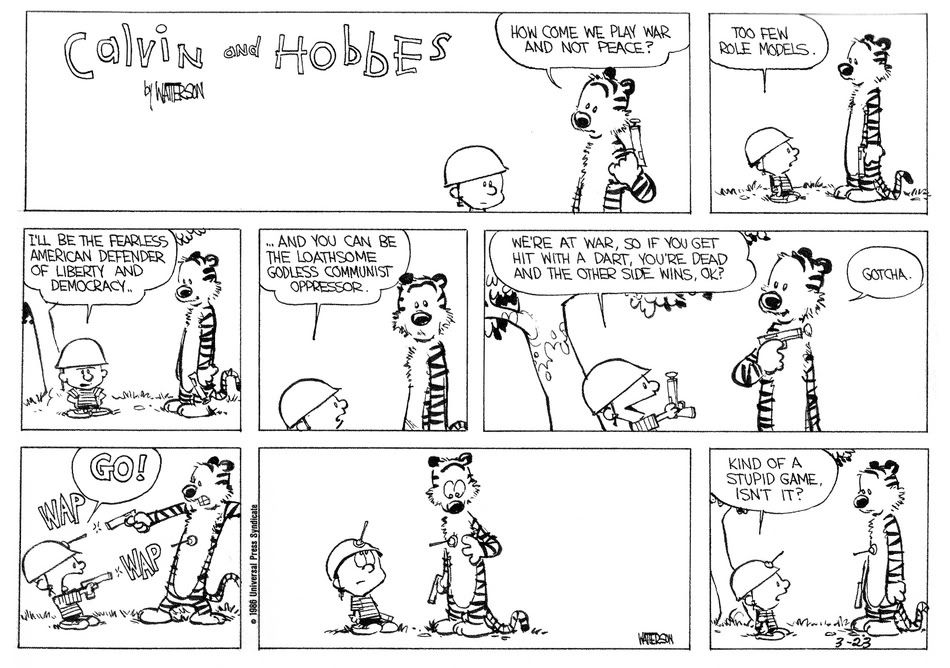
Just War Theory

From the BBC:
What is a Just War?
Six conditions must be satisfied for a war to be considered just:- The war must be for a just cause.
- The war must be lawfully declared by a lawful authority.
- The intention behind the war must be good.
- All other ways of resolving the problem should have been tried first.
- There must be a reasonable chance of success.
- The means used must be in proportion to the end that the war seeks to achieve.
How should a Just War be fought?
A war that starts as a Just War may stop being a Just War if the means used to wage it are inappropriate.- Innocent people and non-combatants should not be harmed.
- Only appropriate force should be used.
- This applies to both the sort of force, and how much force is used.
- Internationally agreed conventions regulating war must be obeyed.
Some reconsiderations from the NY Times Opinionator blog, by Jeff McMahan:
http://opinionator.blogs.nytimes.com/2012/11/11/rethinking-the-just-war-part-1/
http://opinionator.blogs.nytimes.com/2012/11/12/rethinking-the-just-war-part-2/
And...
12 November 2012 – The General Assembly today elected 18 countries to serve on the United Nations Human Rights Council (HRC) for a period of three years beginning on 1 January 2013.
Argentina, Brazil, Côte d’Ivoire, Estonia, Ethiopia, Gabon, Germany, Ireland, Japan, Kazakhstan, Kenya, Montenegro, Pakistan, Republic of Korea, Sierra Leone, United Arab Emirates, United States and Venezuela were elected by secret ballot during the elections held at UN Headquarters in New York.
Members of the Council serve for a period of three years and are not eligible for immediate re-election after serving two consecutive terms.
http://www.un.org/apps/news/story.asp?NewsID=43468&Cr=human+rights+council&Cr1=#.UKGHame8iul
Monday, November 12, 2012

Sunday, November 11, 2012
Media
Agenda-Setting:
"The media doesn't tell us what to think, but what to think about."
http://www.rhetoricalens.info/index.cfm?fuseaction=category.display&category_id=11
"The media doesn't tell us what to think, but what to think about."
"A theory closely related to
agenda-setting is media priming. Iyengar et. al. (1982) developed the
media priming hypothesis in the process of conducting experiments on
agenda-setting as a way to explain how views on public issues can have
real-world political consequences, including the processes guiding the
formation and expression views.[1] The
media priming hypothesis “suggests that the news media influence the
standards by which political figures or public policies are judged by
calling attention to some matters and ignoring others.”[2] As a result, “media alter the standards by which [public] policies or candidates for office are evaluated.”[3]"
http://www.rhetoricalens.info/index.cfm?fuseaction=category.display&category_id=11
Germs and angels
Germs and angels: the role of testimony in young children's ontology.
Source
Graduate School of Education, Harvard University, Cambridge, Massachusetts 02138, USA. Paul_Harris@gse.harvard.eduAbstract
In three experiments, children's reliance on other people's testimony as compared to their own, first-hand experience was assessed in the domain of ontology. Children ranging from 4 to 8 years were asked to judge whether five different types of entity exist: real entities (e.g. cats, trees) whose existence is evident to everyone; scientific entities (e.g. germs, oxygen) that are normally invisible but whose existence is generally presupposed in everyday discourse; endorsed beings (e.g. the Tooth Fairy, Santa Claus) whose existence is typically endorsed in discourse with young children; equivocal beings (e.g. monsters, witches) whose existence is not typically endorsed in discourse with young children; and impossible entities (e.g. flying pigs, barking cats) that nobody believes in. Children make a broad dichotomy between entities and beings that they claim to exist (real entities; scientific entities; and endorsed beings) and those whose existence they deny (equivocal beings and impossible entities). They also make a more fine-grained distinction among the invisible entities that they claim to exist. Thus, they assert the existence of scientific entities such as germs with more confidence than that of endorsed beings such as Santa Claus. The findings confirm that children's ontological claims extend beyond their first-hand encounters with instances of a given category. Children readily believe in entities that they cannot see for themselves but have been told about. Their confidence in the existence of those entities appears to vary with the pattern of testimony that they receive.http://www.cognitionandculture.net/home/news/59-publications/2464-paul-harris-on-how-children-learn-from-others
Stiff Upper Lip: An emotional history of Britain
The history of how the British people went from sentimental folk to stoic "stiff upper lip"
folk through the war and the nationalization of heroes and myths
Good stuff, although it digresses a bit as the episodes go on.
http://www.bbc.co.uk/iplayer/episode/b01n7r80/hd/Ian_Hislops_Stiff_Upper_Lip_An_Emotional_History_of_Britain_Emergence/
Good stuff, although it digresses a bit as the episodes go on.
http://www.bbc.co.uk/iplayer/episode/b01n7r80/hd/Ian_Hislops_Stiff_Upper_Lip_An_Emotional_History_of_Britain_Emergence/

Religion and the U.S. Elections


http://www.pewforum.org/Politics-and-Elections/How-the-Faithful-Voted-2012-Preliminary-Exit-Poll-Analysis.aspx
So here's how the election played out this year in 2012:


If only white people voted, men and women:

If only 24 and older voted:

http://www.buzzfeed.com/buzzfeedpolitics/what-the-2012-election-would-have-looked-like-with
http://thesocietypages.org/socimages/2012/11/11/who-would-have-won-if/

Let us pray...
Amen...and...

CEO Robert E. Murray of Murray Energy, a coal company based in Ohio:
Dear Lord:
The American people have made their choice. They have decided that America must change its course, away from the principals of our Founders. And, away from the idea of individual freedom and individual responsibility. Away from capitalism, economic responsibility, and personal acceptance.
We are a Country in favor of redistribution, national weakness and reduced standard of living and lower and lower levels of personal freedom.
My regret, Lord, is that our young people, including those in my own family, never will know what America was like or might have been. They will pay the price in their reduced standard of living and, most especially, reduced freedom.
The takers outvoted the producers. In response to this, I have turned to my Bible and in II Peter, Chapter 1, verses 4-9 it says, "To faith we are to add goodness; to goodness, knowledge; to knowledge, self control; to self control, perseverance; to perseverance, godliness; to godliness, kindness; to brotherly kindness, love."
Lord, please forgive me and anyone with me in Murray Energy Corp. for the decisions that we are now forced to make to preserve the very existence of any of the enterprises that you have helped us build. We ask for your guidance in this drastic time with the drastic decisions that will be made to have any hope of our survival as an American business enterprise.
Amen.
"Then he fired 156 people."
Washington Post:
http://www.washingtonpost.com/business/economy/after-obama-re-election-ceo-reads-prayer-to-staff-announces-layoffs/2012/11/09/e9bca204-2a63-11e2-bab2-eda299503684_story.html?Post+generic=%3Ftid%3Dsm_twitter_washingtonpost

CEO Robert E. Murray of Murray Energy, a coal company based in Ohio:
Dear Lord:
The American people have made their choice. They have decided that America must change its course, away from the principals of our Founders. And, away from the idea of individual freedom and individual responsibility. Away from capitalism, economic responsibility, and personal acceptance.
We are a Country in favor of redistribution, national weakness and reduced standard of living and lower and lower levels of personal freedom.
My regret, Lord, is that our young people, including those in my own family, never will know what America was like or might have been. They will pay the price in their reduced standard of living and, most especially, reduced freedom.
The takers outvoted the producers. In response to this, I have turned to my Bible and in II Peter, Chapter 1, verses 4-9 it says, "To faith we are to add goodness; to goodness, knowledge; to knowledge, self control; to self control, perseverance; to perseverance, godliness; to godliness, kindness; to brotherly kindness, love."
Lord, please forgive me and anyone with me in Murray Energy Corp. for the decisions that we are now forced to make to preserve the very existence of any of the enterprises that you have helped us build. We ask for your guidance in this drastic time with the drastic decisions that will be made to have any hope of our survival as an American business enterprise.
Amen.
"Then he fired 156 people."
Washington Post:
http://www.washingtonpost.com/business/economy/after-obama-re-election-ceo-reads-prayer-to-staff-announces-layoffs/2012/11/09/e9bca204-2a63-11e2-bab2-eda299503684_story.html?Post+generic=%3Ftid%3Dsm_twitter_washingtonpost
Subscribe to:
Posts (Atom)