To one [C.S. Lewis] who said that myths were lies and therefore
worthless, even though 'breathed through silver'.
Philomythus to Misomythus
You look at trees and label them just so,
(for trees are 'trees', and growing is 'to grow');
you walk the earth and tread with solemn pace
one of the many minor globes of Space:
a star's a star, some matter in a ball
compelled to courses mathematical
amid the regimented, cold, inane,
where destined atoms are each moment slain.
At bidding of a Will, to which we bend
(and must), but only dimly apprehend,
great processes march on, as Time unrolls
from dark beginnings to uncertain goals;
and as on page o'er-written without clue,
with script and limning packed of various hue,
an endless multitude of forms appear,
some grim, some frail, some beautiful, some queer,
each alien, except as kin from one
remote Origo, gnat, man, stone, and sun.
God made the petreous rocks, the arboreal trees,
tellurian earth, and stellar stars, and these
homuncular men, who walk upon the ground
with nerves that tingle touched by light and sound.
The movements of the sea, the wind in boughs,
green grass, the large slow oddity of cows,
thunder and lightning, birds that wheel and cry,
slime crawling up from mud to live and die,
these each are duly registered and print
the brain's contortions with a separate dint.
Yet trees are not 'trees', until so named and seen
and never were so named, tifi those had been
who speech's involuted breath unfurled,
faint echo and dim picture of the world,
but neither record nor a photograph,
being divination, judgement, and a laugh
response of those that felt astir within
by deep monition movements that were kin
to life and death of trees, of beasts, of stars:
free captives undermining shadowy bars,
digging the foreknown from experience
and panning the vein of spirit out of sense.
Great powers they slowly brought out of themselves
and looking backward they beheld the elves
that wrought on cunning forges in the mind,
and light and dark on secret looms entwined.
He sees no stars who does not see them first
of living silver made that sudden burst
to flame like flowers bencath an ancient song,
whose very echo after-music long
has since pursued. There is no firmament,
only a void, unless a jewelled tent
myth-woven and elf-pattemed; and no earth,
unless the mother's womb whence all have birth.
The heart of Man is not compound of lies,
but draws some wisdom from the only Wise,
and still recalls him. Though now long estranged,
Man is not wholly lost nor wholly changed.
Dis-graced he may be, yet is not dethroned,
and keeps the rags of lordship once he owned,
his world-dominion by creative act:
not his to worship the great Artefact,
Man, Sub-creator, the refracted light
through whom is splintered from a single White
to many hues, and endlessly combined
in living shapes that move from mind to mind.
Though all the crannies of the world we filled
with Elves and Goblins, though we dared to build
Gods and their houses out of dark and light,
and sowed the seed of dragons, 'twas our right
(used or misused). The right has not decayed.
We make still by the law in which we're made.
Yes! 'wish-fulfilment dreams' we spin to cheat
our timid hearts and ugly Fact defeat!
Whence came the wish, and whence the power to dream,
or some things fair and others ugly deem?
All wishes are not idle, nor in vain
fulfilment we devise -- for pain is pain,
not for itself to be desired, but ill;
or else to strive or to subdue the will
alike were graceless; and of Evil this
alone is deadly certain: Evil is.
Blessed are the timid hearts that evil hate
that quail in its shadow, and yet shut the gate;
that seek no parley, and in guarded room,
though small and bate, upon a clumsy loom
weave tissues gilded by the far-off day
hoped and believed in under Shadow's sway.
Blessed are the men of Noah's race that build
their little arks, though frail and poorly filled,
and steer through winds contrary towards a wraith,
a rumour of a harbour guessed by faith.
Blessed are the legend-makers with their rhyme
of things not found within recorded time.
It is not they that have forgot the Night,
or bid us flee to organized delight,
in lotus-isles of economic bliss
forswearing souls to gain a Circe-kiss
(and counterfeit at that, machine-produced,
bogus seduction of the twice-seduced).
Such isles they saw afar, and ones more fair,
and those that hear them yet may yet beware.
They have seen Death and ultimate defeat,
and yet they would not in despair retreat,
but oft to victory have tuned the lyre
and kindled hearts with legendary fire,
illuminating Now and dark Hath-been
with light of suns as yet by no man seen.
I would that I might with the minstrels sing
and stir the unseen with a throbbing string.
I would be with the mariners of the deep
that cut their slender planks on mountains steep
and voyage upon a vague and wandering quest,
for some have passed beyond the fabled West.
I would with the beleaguered fools be told,
that keep an inner fastness where their gold,
impure and scanty, yet they loyally bring
to mint in image blurred of distant king,
or in fantastic banners weave the sheen
heraldic emblems of a lord unseen.
I will not walk with your progressive apes,
erect and sapient. Before them gapes
the dark abyss to which their progress tends
if by God's mercy progress ever ends,
and does not ceaselessly revolve the same
unfruitful course with changing of a name.
I will not treat your dusty path and flat,
denoting this and that by this and that,
your world immutable wherein no part
the little maker has with maker's art.
I bow not yet before the Iron Crown,
nor cast my own small golden sceptre down.
In Paradise perchance the eye may stray
from gazing upon everlasting Day
to see the day illumined, and renew
from mirrored truth the likeness of the True.
Then looking on the Blessed Land 'twill see
that all is as it is, and yet made free:
Salvation changes not, nor yet destroys,
garden nor gardener, children nor their toys.
Evil it will not see, for evil lies
not in God's picture but in crooked eyes,
not in the source but in malicious choice,
and not in sound but in the tuneless voice.
In Paradise they look no more awry;
and though they make anew, they make no lie.
Be sure they still will make, not being dead,
and poets shall have flames upon their head,
and harps whereon their faultless fingers fall:
there each shall choose for ever from the All.
source
Saturday, February 28, 2015

Wednesday, January 28, 2015
T.S. Eliot
In the opening pages of Rodney Needham's Belief, Language, and Experience (1972), was the following epigraph:
So here I am, in the middle way, having had twenty years -
Twenty years largely wasted, ... -
Trying to learn to use words, and every attempt
Is a wholly new start, and a different kind of failure
Because one has only learnt to get the better of words
For the thing one no longer has to say, or the way in which
One is no longer disposed to say it. And so each venture
Is a new beginning, a raid on the inarticulate
With shabby equipment always deteriorating. ...
-T. S. Eliot
from 'East Coker'
So here I am, in the middle way, having had twenty years -
Twenty years largely wasted, ... -
Trying to learn to use words, and every attempt
Is a wholly new start, and a different kind of failure
Because one has only learnt to get the better of words
For the thing one no longer has to say, or the way in which
One is no longer disposed to say it. And so each venture
Is a new beginning, a raid on the inarticulate
With shabby equipment always deteriorating. ...
-T. S. Eliot
from 'East Coker'
Defoe quote
Currently, sporadically, reading Camus' The Plague. When I first opened it up, a sentence stilled me:
"It is as reasonable to represent one kind of imprisonment by another, as it is to represent anything that really exists by that which exists not"
"It is as reasonable to represent one kind of imprisonment by another, as it is to represent anything that really exists by that which exists not"
-Daniel Defoe
Monday, January 12, 2015

Craig Martin interviews Talal Asad
Talal Asad: As far as I can tell, most people have
understood that I was trying to think about religion as practice,
language, and sensibility set in social relationships rather than as
systems of meaning. In that book and much of my subsequent work I have
tried to think through small pieces of Christian and Islamic history to
enlarge my own understanding of what and how people live when they use
the vocabulary of “religion.” I certainly did not want to claim that as a
historical construct “religion” was a reference to an absence, a mere
ideology expressing dominant power. It was precisely because I was
dissatisfied with the classical Marxist notion of ideology that I turned
my attention to religion. I was gradually coming to understand that the
question I needed to think about was how learning a particular language
game was articulated with a particular form of life, as Wittgenstein
would say. The business of defining religion is part of that larger
question of the infinite ways language enters life. I wanted to get away
from arguments that draw on or offer essential definitions: “Religion
is a response to a human need,” “Religion may be a comfort to people in
distress but it asserts things that aren’t true,” “Religion is
essentially about the sacred,” “Religion gives meaning to life,”
“Religion and science are compatible/incompatible,” “Religion is
responsible for great evil,” “So is science —and religion is also a
source of much good,” “No, science is not a source of evil, as religion
often is; it is technology and politics that are the problem—the social
use to which science is put.”
I argued that to define “religion” is to circumscribe certain things (times, spaces, powers, knowledges, beliefs, behaviors, texts, songs, images) as essential to “religion,” and other things as accidental. This identifying work of what belongs to a definition isn’t done as a consequence of the same experience—the things themselves are diverse, and the way people react to them or use them is very different. Put it this way: when they are identified by the concept “religion,” it is because they are seen to be significantly similar; what makes them similar is not a singular experience common to all the things the concept brings together (sacrality, divinity, spirituality, transcendence, etc.); what makes them similar is the definition itself that persuades us, through what Wittgenstein called a “captivating picture,” that there is an essence underlying them all—in all instances of “religion.”
The things regarded as hanging together according to one conception of religion come together very differently in another. That’s why the translation of one “religious” concept into another is always problematic. But Genealogies doesn’t argue that the definition of religion is merely a matter of linguistic representation. Religious language—like all language—is interwoven with life itself. To define “religion” is therefore in a sense to try and grasp an ungraspable totality. And yet I nowhere say that these definitions are abstract propositions. I stress that definitions of religion are embedded in dialogs, activities, relationships, and institutions that are lovingly or casually maintained—or betrayed or simply abandoned. They are passionately fought over and pronounced upon by the authoritative law of the state.
Definitions of religion are not single, completed definitive acts; they extend over time and work themselves through practices. They are modified and elaborated with continuous use. To the extent that defining religion is a religious act, whether carried out by “believers” or “nonbelievers,” it may also be an attempt at attacking or reinforcing an existing religious tradition, at reforming it or initiating a new one.
My problem with “universal definitions of religion,” therefore, has been that by insisting on a universal essence they divert us from asking questions about what the definition includes and what it excludes, how, by whom, for what purpose; about what social/linguistic context it makes good sense to propound a given definition and when it doesn’t.
more here
I argued that to define “religion” is to circumscribe certain things (times, spaces, powers, knowledges, beliefs, behaviors, texts, songs, images) as essential to “religion,” and other things as accidental. This identifying work of what belongs to a definition isn’t done as a consequence of the same experience—the things themselves are diverse, and the way people react to them or use them is very different. Put it this way: when they are identified by the concept “religion,” it is because they are seen to be significantly similar; what makes them similar is not a singular experience common to all the things the concept brings together (sacrality, divinity, spirituality, transcendence, etc.); what makes them similar is the definition itself that persuades us, through what Wittgenstein called a “captivating picture,” that there is an essence underlying them all—in all instances of “religion.”
The things regarded as hanging together according to one conception of religion come together very differently in another. That’s why the translation of one “religious” concept into another is always problematic. But Genealogies doesn’t argue that the definition of religion is merely a matter of linguistic representation. Religious language—like all language—is interwoven with life itself. To define “religion” is therefore in a sense to try and grasp an ungraspable totality. And yet I nowhere say that these definitions are abstract propositions. I stress that definitions of religion are embedded in dialogs, activities, relationships, and institutions that are lovingly or casually maintained—or betrayed or simply abandoned. They are passionately fought over and pronounced upon by the authoritative law of the state.
Definitions of religion are not single, completed definitive acts; they extend over time and work themselves through practices. They are modified and elaborated with continuous use. To the extent that defining religion is a religious act, whether carried out by “believers” or “nonbelievers,” it may also be an attempt at attacking or reinforcing an existing religious tradition, at reforming it or initiating a new one.
My problem with “universal definitions of religion,” therefore, has been that by insisting on a universal essence they divert us from asking questions about what the definition includes and what it excludes, how, by whom, for what purpose; about what social/linguistic context it makes good sense to propound a given definition and when it doesn’t.
more here
Saturday, January 10, 2015
*Of course, it's "socially constructed"
Of course, 'culture' and 'religion' are socially constructed. A lot of "things" and "stuff" are socially motivated man-made constructs. But this does not divorce them from their roots or particular histories. Calling something out as "socially constructed" doesn't do much anymore and it certainly doesn't negate its history. At some point, the re-appropriation and bastardization of non-white culture has been driven by a fascination of "otherness", a romanticization (or demonization) of a "mystique", and arguably driven by a western marketing phenomenon for 'originality', being 'unique', and bricolage 'spirituality'. The contemporary political economy drives capitalization to sever 'culture' from its historical roots for the sake of "fashion", "trend", and "art". This is not to say that it cannot or should not be appreciated, quite the contrary, it should be appreciated, understood, and respected, accompanied by the significance of its local value and sense of history.
*appropriately, this discussion changes in various ways depending on what it is we're talking about and its context.
*appropriately, this discussion changes in various ways depending on what it is we're talking about and its context.
Friday, January 9, 2015

Thursday, January 8, 2015
*Experiencing 'time'...
These days, time only seems to exist when I have an outside engagement. Right before (some phenomenologically arbitrary measure of 'before') the time of meeting - whether it be for a seminar, lecture, meeting with a professor, friend or colleague - 'time' comes into existence reminding me that there is a conventional clock by which we hold our promises. In this sense, it would seem that 'time' is inexplicably tied up with 'integrity'; being some place at some time to meet some one after making the agreement to meet.
This is the only instance when 'time,' at least nowadays, seems to exist. Of course, I am completely being self-absorbed and utterly dismissive of the movements of the sun and the moon. But socially speaking the abstraction of 'time,' constructing a standardized measure of movement for the purposes of cooperation and coordination, among other things, serves to control and test the 'integrity' by which we proceed in our trajectories.
All that exists, in this period of my life, is my dissertation and my computer (through which I am connected to family, friends, and social happenings - which could warrant the argument that a computer, and its functions, with the conjunction that the internet gives access to the world, is the social. In a Durkheimian way, the computer could be argued to be 'God').
Otherwise I'm like:

And on most days...

Wednesday?
This is the only instance when 'time,' at least nowadays, seems to exist. Of course, I am completely being self-absorbed and utterly dismissive of the movements of the sun and the moon. But socially speaking the abstraction of 'time,' constructing a standardized measure of movement for the purposes of cooperation and coordination, among other things, serves to control and test the 'integrity' by which we proceed in our trajectories.
All that exists, in this period of my life, is my dissertation and my computer (through which I am connected to family, friends, and social happenings - which could warrant the argument that a computer, and its functions, with the conjunction that the internet gives access to the world, is the social. In a Durkheimian way, the computer could be argued to be 'God').
Otherwise I'm like:
And on most days...
Wednesday?
Individual and Society
Although sociology is defined as the science of society, in reality it cannot deal with human groups, which are the immediate concern of its research, without in the end tackling the individual, the ultimate element of which these groups are composed. For society cannot constitute itself unless it penetrates individual consciousnesses [sic] and fashions them ‘in its image and likeness.’
Emile Durkheim
… in one sense it is very true that every psychological phenomenon is a sociological phenomenon, the mental element being identified with the social one. But, in another sense, everything is reversed. The proof as to what is social can only be a mental one; in other words, we can never be sure we have fathomed the meaning and function of an institution if we are not capable of reliving its impact upon the individual consciousness. As such an impact is an integral part of institutions, any interpretation must aim to match the objectivity of the historical or comparative analysis with the subjectivity of the experience as it has been lived.
Claude Levi-Strauss
Wednesday, January 7, 2015
Saturday, January 3, 2015

Saturday, December 27, 2014
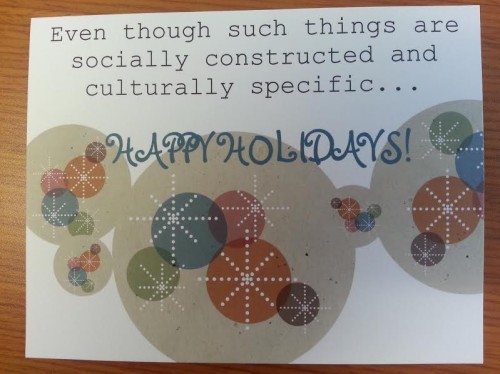
Thursday, December 25, 2014
Berlin: Tolerance
"If there is only one solution to the puzzle, the the only problems are firstly how to find it, then how to realise it, and finally how to convert others to the solution by persuasion or by force. But if this is not so (Machiavelli contrasts two ways of life, but there could be, and, save for fanatical monists, there obviously are, more than two), then the path is open to empiricism, pluralism, toleration, compromise. Toleration is historically the product of the realisation of the irreconcilability of equally dogmatic faiths, and the practical improbability of complete victory of one over the other. Those who wished to survive realised that they had to tolerate error. They gradually came to see merits in diversity, and so became sceptical about definitve solutions in human affairs.
...
To know the worst is not always to be liberated from its consequences; nevertheless it is preferable to ignorance. It is this painful truth that Machiavelli forced on our attention, not by formulating it explicitly, but perhaps the more effectively by relegating much uncriticised traditional morality to the realm of Utopia."
...
To know the worst is not always to be liberated from its consequences; nevertheless it is preferable to ignorance. It is this painful truth that Machiavelli forced on our attention, not by formulating it explicitly, but perhaps the more effectively by relegating much uncriticised traditional morality to the realm of Utopia."
-Isiah Berlin, 'The Originality of Mahiavelli'
Tuesday, December 23, 2014
Berlin: Philosophy is a moral vocation
"Yet,
despite every effort to separate them, conducted by a blind scholastic
pedantry, politics has remained indissolubly intertwined with every
other form of philosophical enquiry. To neglect the field of political
thought, because its unstable subject matter, with its blurred edges, is
not to be caught by the fixed concepts, abstract models and fine
instruments suitable to logic or to linguistic analysis - to demand a
unity of method in philosophy, and reject whatever the method cannot
successfully manage - is merely to allow oneself to remain at the mercy
of primitive and uncriticised political beliefs."
Berlin, I. (1958) “Two Concepts of Liberty.”
more here
Berlin, I. (1958) “Two Concepts of Liberty.”
more here
Subscribe to:
Posts (Atom)